Dear Friends,
With this letter, I want to share a part of our journey — not just the milestones,
but the uncertainty, the debates, the technical struggles, and the quiet decisions
that shape a company before the world sees it.
This is not only a memory for us.
It is a record of courage — and perhaps a reflection that may help another entrepreneur
standing at the edge of doubt.
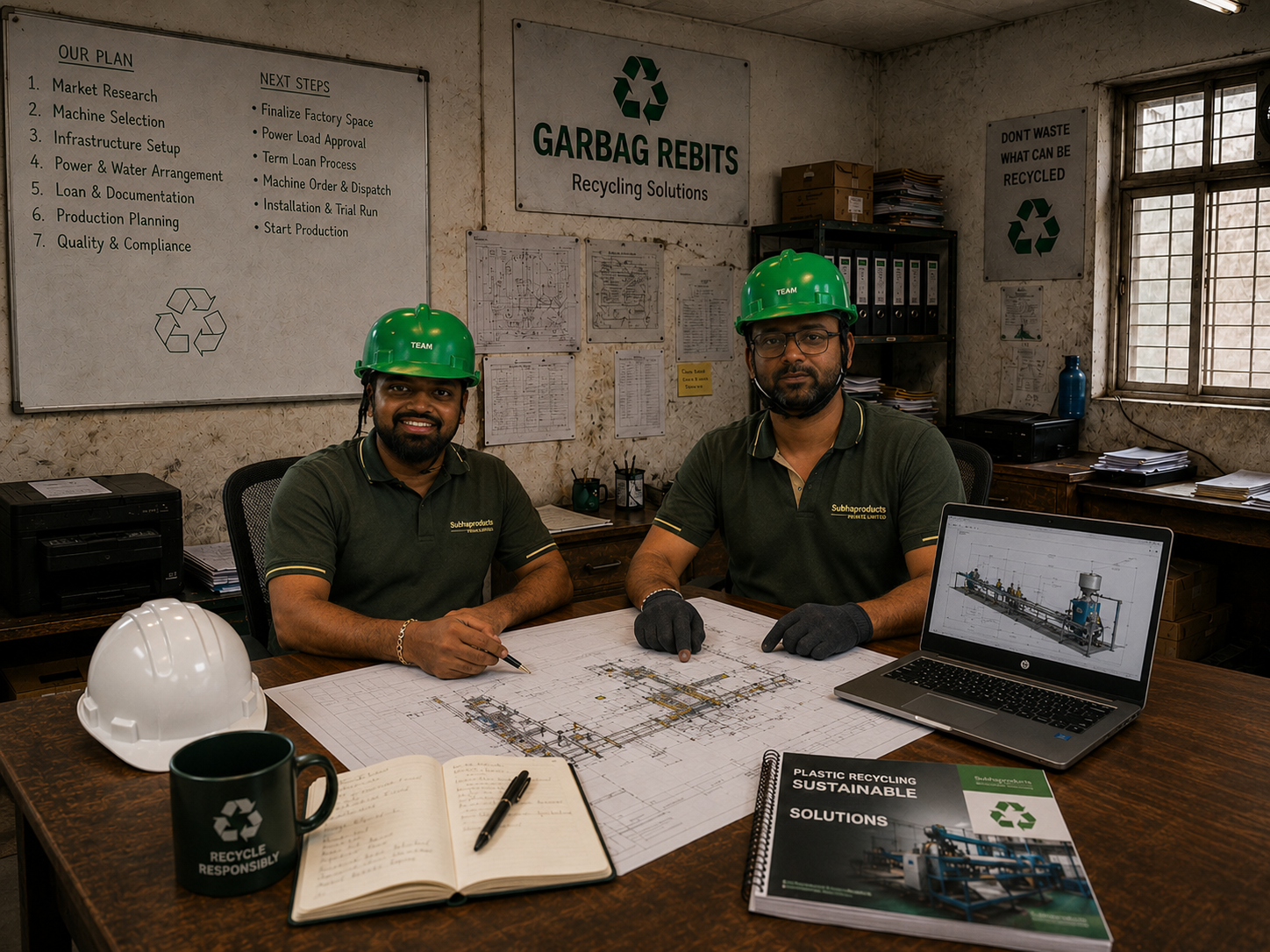
For the last four to five months, Ronak and I have been in continuous discussions
about starting our recycling production unit. Our market survey was completed.
Initial R&D had been done. The groundwork looked ready.
Yet, despite preparation, one question kept returning:
Is this the right time?
Every entrepreneur knows this phase — when logic says move forward,
but responsibility demands deeper thinking.
As partners, we were not just investing money.
We were investing belief.
The second challenge was even more complex:
What kind of machine should we invest in?
What capacity?
What technology?
Plastic recycling is not as simple as feeding raw material into a machine
and getting finished output.
There are multiple polymers — LDPE, HDPE, PP — and even within them,
different categories such as film grade, molding grade,
multilayer materials, and contaminated waste streams.
Each behaves differently.
Each demands different screw configurations, temperature profiles,
filtration systems, and processing technologies.
And our focus was not on easy plastic.
We were determined to work on
diaper recycling and multi-layer plastic (MLP)
— materials that most recyclers avoid because they are complex,
contaminated, and technologically demanding.
Our core idea was clear:
“If we are entering this industry,
we will work on what is considered difficult to recycle.”
That decision changed everything.
Machine selection was no longer just about price —
even though, as a startup, cost is always a constraint for us.
• It was about adaptability.
• It was about screw design.
• It was about filtration strength.
• It was about whether the system could handle multiple products.
We began deep technical discussions with machine manufacturers.
We evaluated their technology, studied their extrusion systems,
examined screw designs, discussed our required modifications,
and negotiated specifications.
We visited multiple facilities.
We compared quotations.
We challenged assumptions — both theirs and ours.
For two months, the only thing constant was discussion.
Finally, after long negotiations and technical evaluations,
we finalized our machine.
But as every entrepreneur knows —
one decision only opens the door to the next challenge.
Now begins the next phase:
• Finalizing a rented industrial space
• Ensuring adequate power load
• Securing water infrastructure
• Applying for a term loan
• Structuring financial discipline from day one
This is the invisible side of building a recycling company —
the part people don’t see when they hear about innovation.
What we are building is not just a plant.
It is a system.
A system designed to handle materials that society discards without thought.
Recycling, especially in complex waste streams like diapers and MLP,
is not glamorous.
It is technical.
It is capital-intensive.
It demands patience.
But it also carries responsibility.
If we want a circular economy,
someone has to build the infrastructure for it.
“We have chosen to be that someone.”
The journey ahead will not be simple.
There will be operational challenges,
financial pressures,
and moments of doubt.
But every challenge strengthens conviction.
We are still at the beginning.
But we are committed.
And this is just the start.
We will continue to share our journey,
experiences, and learnings here —
as we build, evolve, and move forward.
With determination,
Co-Founders
.png)